Thailand (Mae Wang): Two Nights in the Jungle! – by Barb

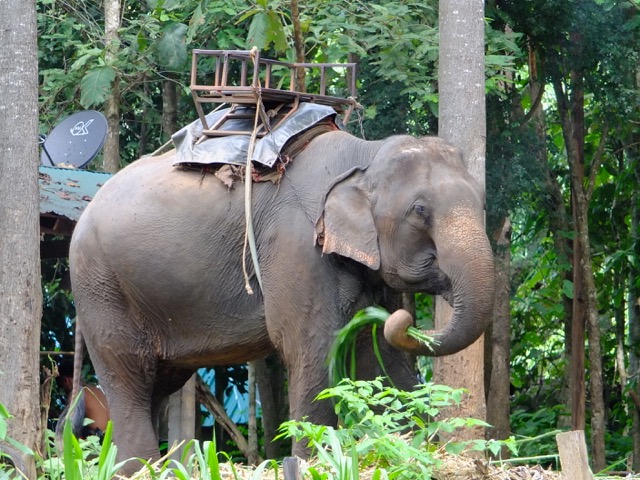
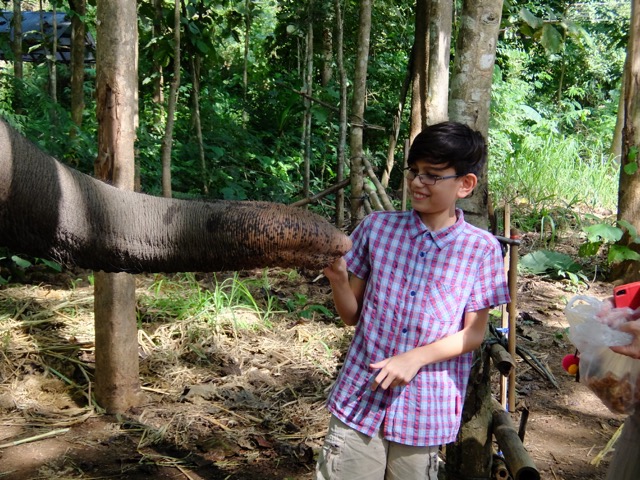
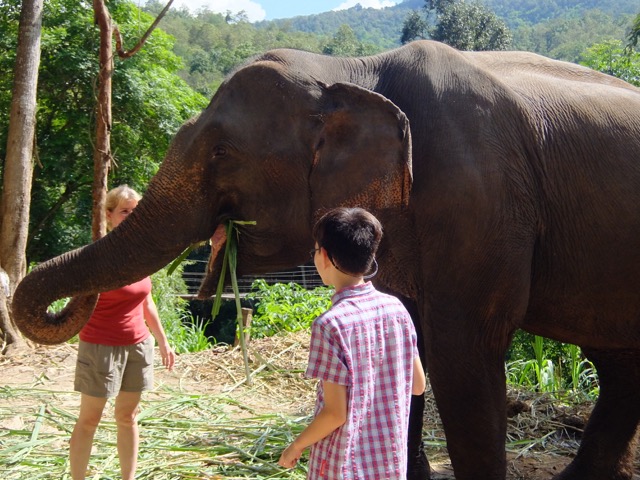
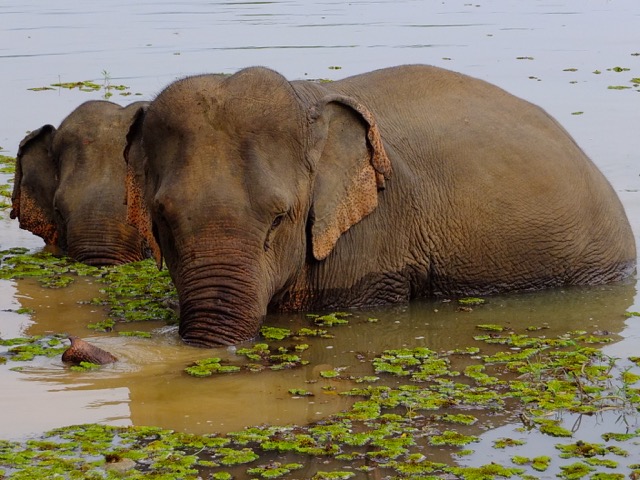
After 5 days in the city of Chiang Mai, it was time for us to head outside the city to an area called Mae Wang, where we would be staying at CDSCF9607hai Lai Orchid – a guest house in the jungle close to an elephant camp.  The Chai Lai Orchid works to promote sustainable tourism, kindness to elephants, and helps at-risk womDSCF9991en take the first step to get out of poverty and see a future of hope. The eco-lodge is located adjacent to an elephant camp which still uses chairs on the backs of the elephants to provide rides for tourists. This camp, like so many in Thailand, is reluctant to change its business model because they fear tourists will go elsewhere to find cheap chair rides and elephant shows. Chai Lai Orchid is hoping to raise enough money to run the elephant camp, showing others that tourists are happy to spend time watching and bathing the elephants, and thereby set an example for the  humane and ethical treatment of both elephants and mahouts. DSCF0030
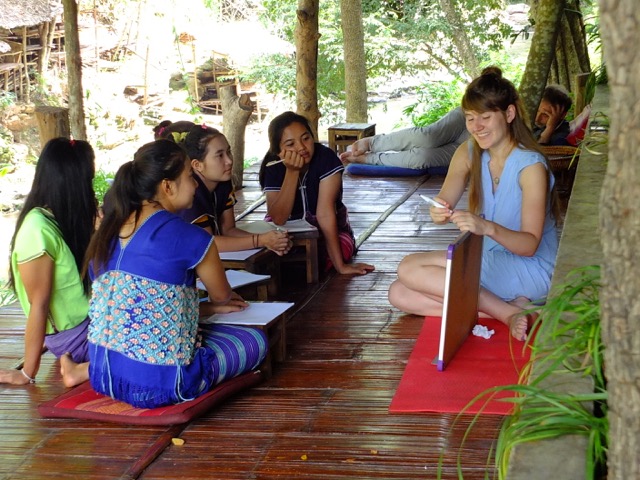
In addition to helping the elephants, Chai Lai employs young mothers and at-risk girls who have been denied education through circumstance. Chai Lai Orchid teaches the women about working in a hotel so when they graduate, they can find stable employment in Thailand’s growing hospitality industry. They also attend English and computer classes, seminars on women’s health, nutrition, trafficking and their rights.
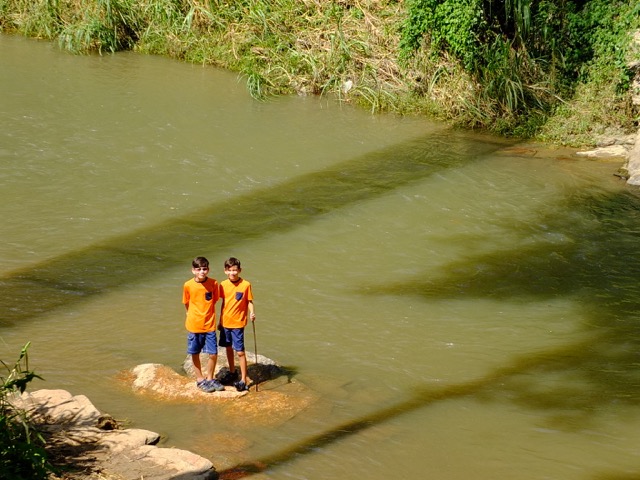
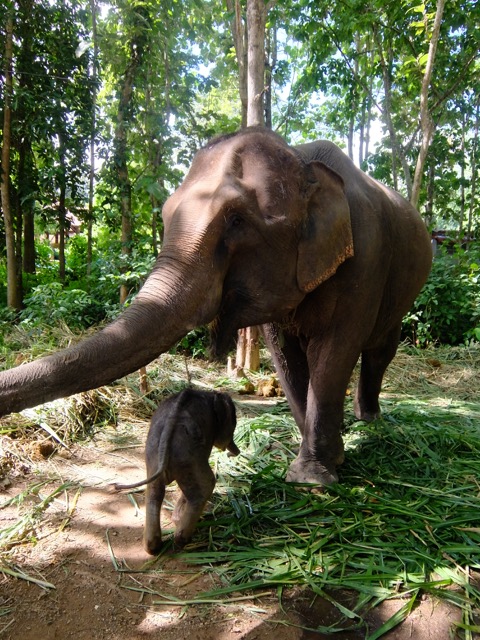
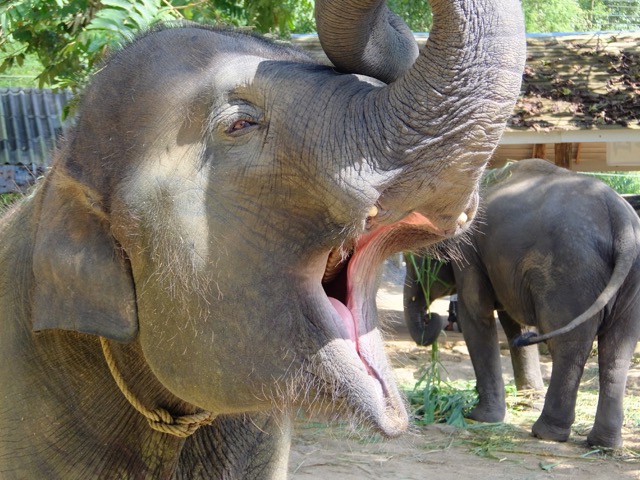
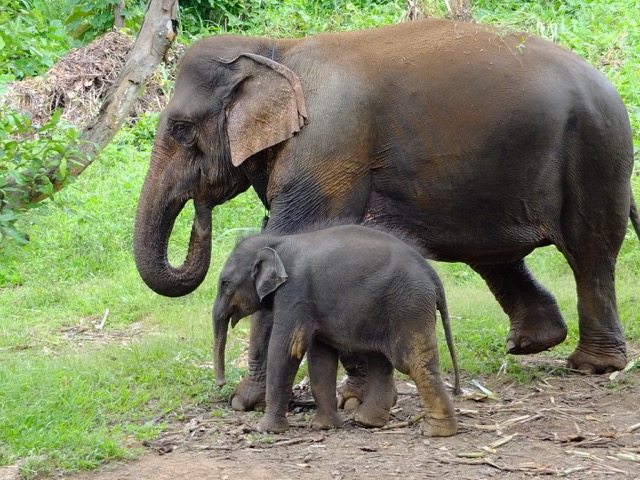
This was one of my favourite places to stay so far on our journey. It was nice to be in the jungle. The boys loved the river, which was a great way to cool off in the tropical heat. We were also able to hire a bamboo raft and go rafting down the river rapids. We enjoyed watching the elephants  walk past us. To top it off  a new baby elephant had just been born the week before! It was also great to know that our money was going to support a good cause.
DSCF0034
The boys on the river, just outside our room.
 DSCF9611
Proud Momma with her new calf.
DSCF9615  DSCF9625 DSCF9631
Visiting with the elephants.
DSCF9638
DSCF9648
DSCF9651
DSCF9977
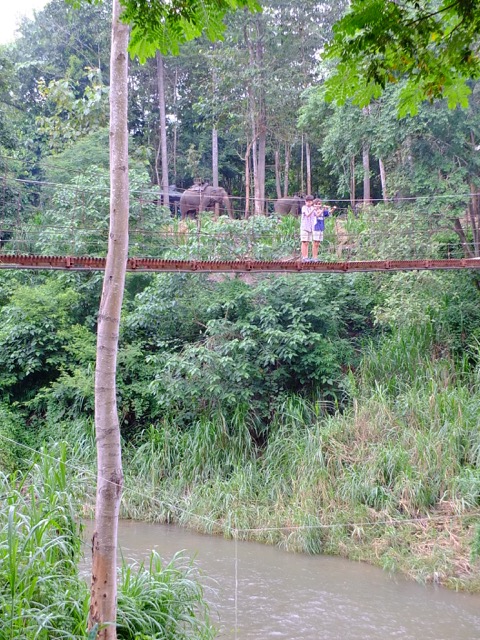
The bridge across to our “Jungle Lodge”. We only brought our backpacks here. Good thing! Wouldn’t want to have to roll a big bag across this bridge! (Although people drove across on their motorcycles!)
DSCF9981
Barb working at the lodge restaurant.
DSCF9985
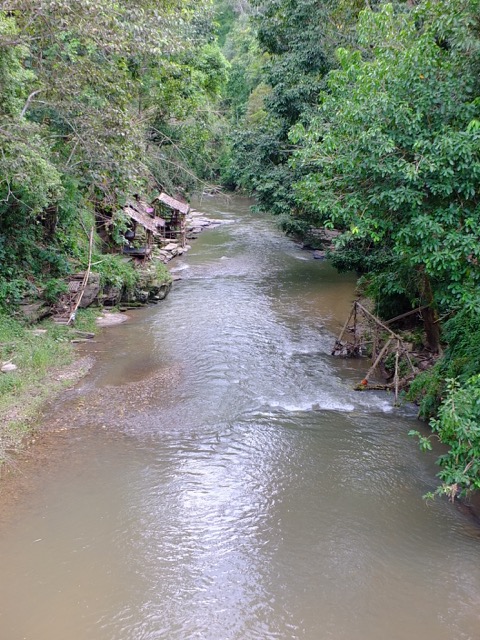
The river we rafted on, and swam in. (Fortunately it wasn’t until our last day that we noticed the very large water snakes on the river bank!!)
DSCF9987
Good bye, Chai Lai Orchid! We loved staying here!

Thailand (Chiang Mai): Biking Southern Chiang Mai

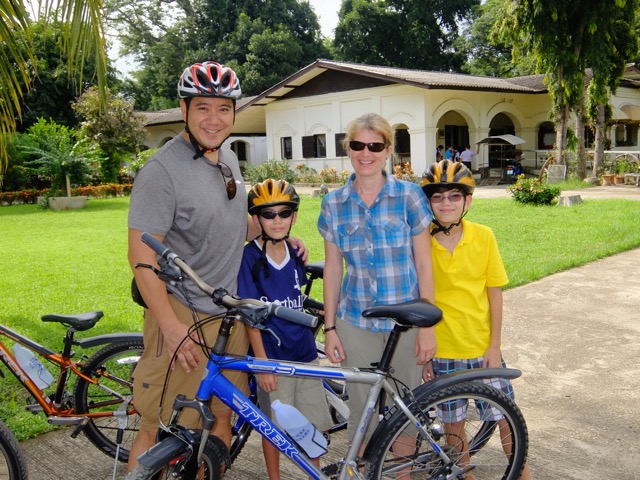
To get a better sense of Chiang Mai, we decided to take a bicycle tour south of the city. We DSCF9556rented bikes and cycled (with a guide) around the southern part of Chiang Mai. We took side streets, so the biking was great – not much traffic to worry about and the scenery was beautiful in spots. We traveled through many small villages and it really felt like we were miles from the city.

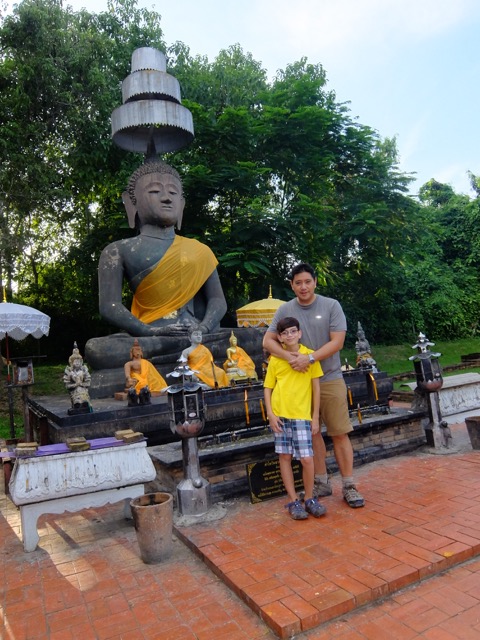
We stopped to visit a 100-year-old temple that had been moved by the villagers due to flooding.

DSCF9545

DSCF9549

We also visited a rehabilitation facility that used to be the location of a Leper colony. A few of the original patients with leprosy still called the place home and they created crafts to sell at the local store. Some of their cards and artwork is shipped around the world. We purchased a collection of their Christmas cards.

DSCF9555

We learned about cremation at the village crematorium.

DSCF9567

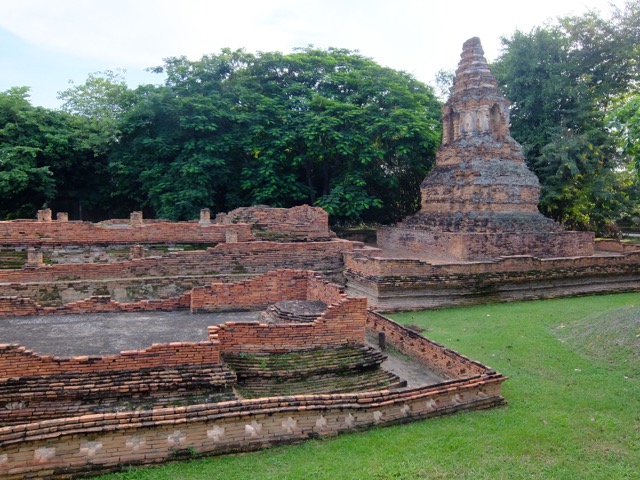
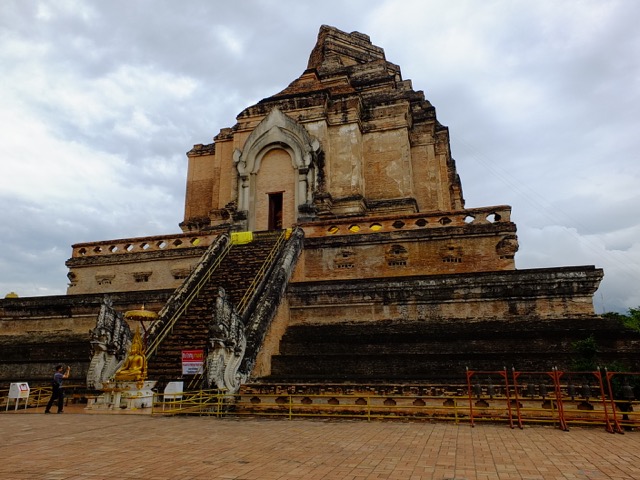
Near the end of our ride we saw the ruins of some of the ancient temples from the original Lanna Kingdom. 

DSCF9584


DSCF9573

It was a great way to learn more about Chiang Mai and its people.

Thailand (Chiang Mai): Chatting with Monks – by All of Us!

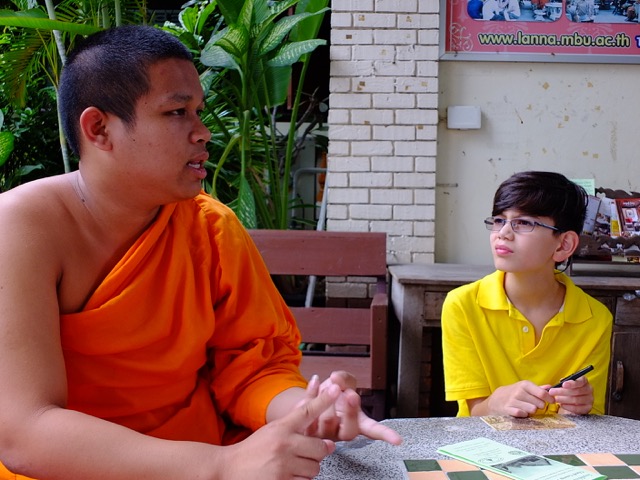
One day we went to a temple in Chiang Mai where you could chat with the monks about their lives and Thai culture in general. DSCF9919


We sat at a picnic table with a young novice monk named Boi who was 19 years old and was about to decide whether to continue as a full monk or not.


DSCF9947


We asked Boi about Buddha and his daily routine. He told us how he had to wake up every day at 5:00 a.m. to collect alms and pray and study. He also explained how monks cannot eat past noon and they can only eat the food that is collected as alms (offerings by the common people in return for a spiritual blessing).


Boi came from a vDSCF9925ery poor village and being a novice monk provided him the opportunity to study English and teaching. He wore a bright orange robe (apparently the colour orange repels mosquitos) and his hair was shaved very closely so it was both easy to care for and to signify that monks were not be concerned about personal appearance.

DSCF9976


We thanked Boi for speaking with us and educating us about his culture. He in turn thanked us for the chance to practice his English. He shook our hands, with the exception of Barb, as monks are not allowed to touch women.    DSCF9968

Thailand (Chiang Mai): A Thai Massage! – by All of Us!

You can’t visit Thailand without having a massage! There are massage parlours every 20 meters, on every street imaginable – kind of like Tim Horton’s back home. Connor was particularly excited because he lThailand_Koh_Mak_Ao_Khao_Beach_sign_massage_3339_1oves massage. They begin by scrubbing your feet in lime water. Then you are led to a pallet where they twist and bend your body in unnatural positions. Barb, Caleb, and Connor had Back, Neck, and Head massages and Clay had the traditional Thai massage. The experience was not what Caleb was expecting. He thought it would be gentle and soothing but he felt like a piece of pretzel dough being pounded. Connor, on the other hand, actually fell asleep at points because he found it so relaxing. They also had an à la carte menu of services so you could choose what kind of massage you wanted.


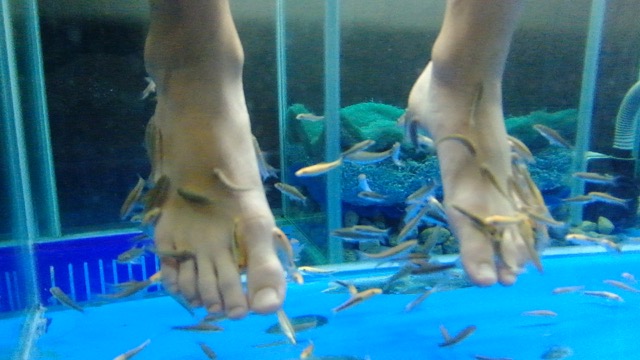
Another neat experience that the boys tried was the Fish Spa. You put your feet in a tank full of little fish and they come up and suck the dead skin off of your feet. It was a good thing no one else was there when we went because the boys couldn’t stop giggling! They thought it felt so funny to have the feet nibbling at your toes!

DSCF9601

Thailand (Chiang Mai): Tales from Thailand – by Barb

We arrived in Chiang Mai on a Saturday, which is the day of the Saturday Night Market. We enjoyed wandering through the market and sampling various treats: mango with coconut sticky rice, chicken satay, fruit shakes, waffles. Eating at the night market is fun and very cheap! IMG_0214
On Sunday there was another night market even closer to our Guest House so we got to sample even more yummy food, and re-sample the things we had enjoyed most from the day before!
Caleb was really interested in the artisans at the market and wanted to purchase something that would: a) support a local artist, and b) be a nice souvenir to take home. He ended up deciding on an abstract painting of elephants. 
We also visited the Museum of Arts and Culture, which taught us about the history of Chiang Mai. It was very well done AND had air conditioning, so we were able to spend a few hours there. There was a video that gave you a brief overview of Chiang Mai’s history and on the second floor there were full scale dioramas of villages set up. 
DSCF9493

Laos (Sayabouri): Elephant Conservation – by Caleb and Connor

We were all very excited about our next experience in Laos. We were going to spend 2 days at the ElephantDSCF9676 Conservation Centre in Sayabouri, 3 hours from Luang Prabang. After a bus ride, followed by a short boat ride across the lake, we arrived at the centre.

The Elephant Conservation Centre has been created to help elephants in Laos. For many years elephants were used to haul logs out of the forest in Laos. Being a “mahout” (elephant trainer and caretaker) was considered a well-respected profession. Now in Laos much of the land has been “over logged” so the government no longer allows logging in many areas, and the use of elephants for this work is prohibited. This has changed the role of the elephant and the mahout. Tourism has become a common use for the elephant with elephant camps offering visitors lengthy rides on elephants and mahout training sessions (which are really just elephant riding lessons). The elephants are often not well treated at these camps, since they are viewed as just tools for the business. They are not given enough time to eat or rest and are often not fed a well-balanced diet. At the Elephant Conservation Centre they want to educate Lao people about the proper treatment of elephants. They want to increase the number of healthy captive elephants in Laos and help the mahout profession regain the respect it deserves. They agree that tourism can be a good for Laos and the elephants but feel that it should centre around education about the elephants not riding and misusing them.

Our visit to the Elephant Conservation Centre began at the elephant museum where they have books and posters with information about elephants. We learned the difference between African Elephants and Asian Elephants:DSCF9708    DSCF9739    DSCF9872

  • Asian elephants have 2 domes on their heads, while African elephants have 1
  • African elephants are almost double the size
  • Female Asian Elephants don’t have tusks (or they are very short and hidden) but both males and females African Elephants have tusks
  • Elephants have pads on the backs of their feet
  • The trunk has about 127 muscles and no bones
  • Elephants do not see well. They have 3 eyelids and they are colour blind.

After learning about Asian elephants we got to visit with the elephants at the centre and a mahout showed us the three different ways to safely mount an elephant. Next, we each had a chance to ride the elephants. Elephants should be ridden on the neck, with your legs right behind the ears. It is not good for the elephant’s spine if you sit on her back, or if you mount a chair on the back to ride it. An elephant’s ears must always be free to move back DSCF9721and forth because this is how she stays cool and circulates its blood. Elephants should only be ridden for short periods (3 hours or so) because they neeDSCF9719d to rest and eat.

We followed the elephants to the jungle where they stay and eat for the night. Elephants eat about 250 kg each day and they can urinate up to 50 L at one time! Elephants eat about 18 hours a day and sleep for 4. They do not sleep consecutivelyDSCF9722 but stop and sleep for a few minutes and then continue eating. When they sleep, their ears droop and stop moving but when they wake they start moving their ears again. We also saw the elephant garden, which was a large area in the jungle filled with different kinds of trees and grasses.

DSCF9757

On our second day, we got to go and visit the elephant nursery where there was an 8 month-DSCF9827old baby elephant with her mother. Elephants weigh about 150 kg when they are born. They can stand up right away. Their mothers teach them how to swim and eat. Elephants stay in their mother’s tummy for about 22 months – a long time! They drink their mother’s milk for 2-3 years but they can begin eating small pieces of sugar cane from about 8 months.

After seeing the baby elephant we visited the elephant hospital. The vet technician told us about elephants’ health and illnesses. He also shoDSCF9881wed us the target training they do to prepare the elephants should they ever need shots and medication. For the target training the elephant is brought into a wooden enclosure and is DSCF9843fed treats every time she does what the veterinarian asks. For example, “foot up”.

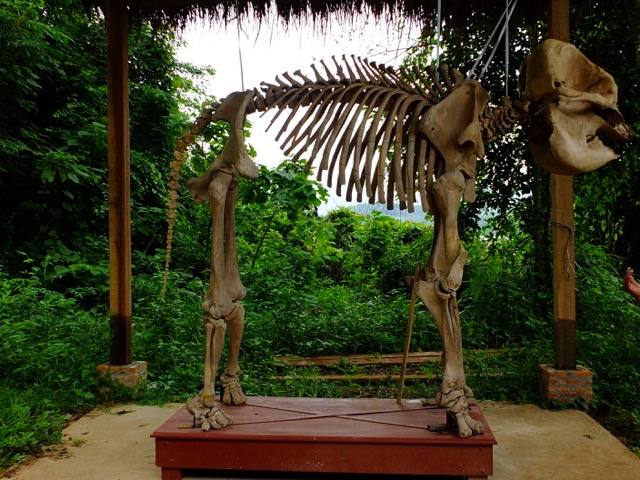
Behind the hospital was an elephant skeleton of a female elephant who had died of old age. Elephants often die beside the river because they need to continue to drink the water.DSCF9884

We really enjoyed our visit to the Elephant Conservation Centre and we learned a lot. We wished we could have stayed longer. It was fascinating to watch the elephants and it was amazing to ride one.

Laos (Luang Prabang to Sayaburi): Travelling Around Laos by Bus – By Barb

When it’s time for us to travel between cities in Laos, we can just never be sure what kind of a bus adventure we are in for! Our very first bus ride in Laos, from Vientiene to Vang ViIMG_0096eng, we lucked out and got a nice VIP bus. Although we had to cram onto a far-too-small tuk tuk, with all of our heavy luggage, to get to the bus, once we arrived we boarded a modern-looking, air conditioned bus, not unlike a Greyhound bus back in Canada. Yes, we did have to wait about an hour while they figured out what to do with the extra passengers since they had over-filled the bus (they ended up putting some in a minivan) but all in all, it was a pretty uneventful experience. Caleb, and I get motion sickness but fortunately the road to Vang Vieng is so bad, with ruts and potholes that the bus can’t go over 40 km/hour. Between that, and having to wait for herds of cows to clear the road, the bus didn’t go fast enough for us to worry about any nausea!

Our bus ride from Vang Vieng to Luang Prabang was a slightly different experience, as you may recall from Clay’s blog. What you must realize, however, is that since Clay is the only one of us who doesn’t suffer from any motion sickness, a bus ride for him generally means finding a seat near the back of the bus and settling in to read his book or falling off to sleep (which he can do almost instantaneously) and therefore I would not consider him a reliable source when recounting the details of our bus adventures! Let me give you the full account below.

I had done the research on buses from Vang Vieng to Luang Prabang (yes, I am the researcher and organizer for this trip!) and knew that it was going to be long and painful. Every book I read mentioned that you should take motion sickness medication for the ride if you have ever had any issues with car-sickness at all. Also, the ride took 7-8 hours: this could feel like a lifetime if it is spent with your head in a sick bag.

Anyway, I had prepared for the trip: we had collected sick bags from various sources (double lined grocery sacks, bags from the backs of our airplane seats, etc). We purchased a few anti-nausea snacks (Ritz crackers: yes, we found some at the mini grocer!). We ate a “keep it down” breakfast of baguette, yogurt and muesli. And Caleb and I took anti-nausea medication.

But just as we arrived at the depot to get the tickets, two tourists spoke to Clay about how much better it was to take the minibus than the big bus – because apparently it swayed much less from side to side going around the many curves.

Word of advice: BE CAUTIOUS WHEN TAKING THE ADVICE OF OTHERS!

So, needless to say we bought tickets for the minibus. They were quite a bit cheaper than the VIP bus (which did make me wonder!!). We waited on the street for the bus to show up, and up pulled a nice little minivan, with tinted windows and air conditioning. “Ah, this will be better!” I thought. “Not your bus,” said the lady who had sold us the tickets. “Oh dear,” not a good sign!

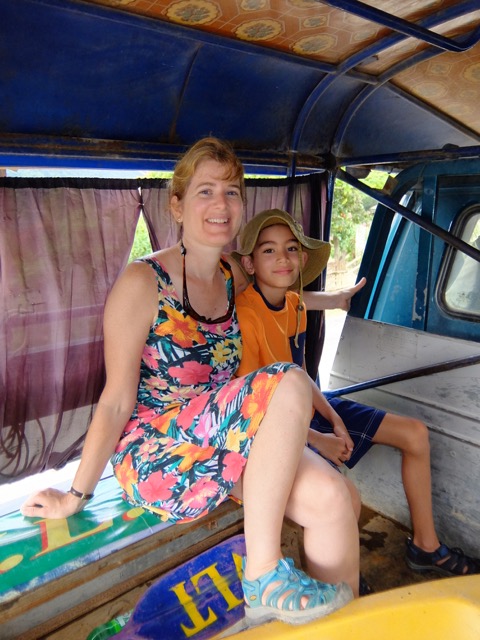
Instead, a few minutes later a truck pulled up and we were told to climb in the back because, “Take you to your bus” the lady remarked. Off we went, with an all too familiar feeling that we would be cramming this truck to the brim with travelers and their bags. Sure enough we drove around until we were packed full and then pulled into a gas station where a man told us to get out.DSCF9222

This is where we went wrong! We are so used to trying to teach the boys to be considerate of others that we didn’t jump out of the truck and run to the waiting mini-vehicle-thing and try to get seats together near the front. Instead we helped people out with their heavy bags and Clay stayed to hoist the big bags onto the top of our new mode of transportation.

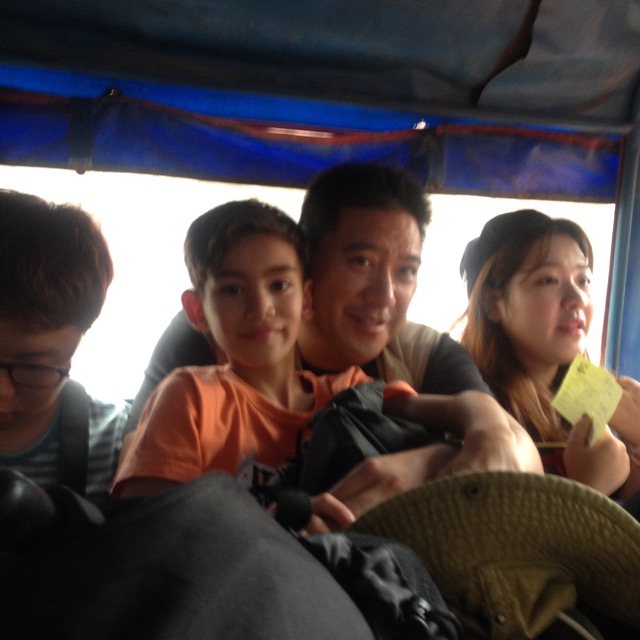
When we finally looked in to get our seats, the bus/van was nearly full. Clay and Caleb took 2 seats near the back (because we didn’t think Connor suffered from motion sickness at this point!). Caleb managed to get a seat by the side door and I sat in the row in front of him with two Korean gentlemen. Already the van was full – with 13 of us and backpacks squished between our knees and the seats. Off we went and I double-checked that the sick bags were within arms reach.

We had only traveled 3 or 4 km down the road when the van pulled over to pick up a Lao woman with her bag. People in the front row moved over to make space and off we went again. I was happy at this point, that the road was still very bad and there were lots of cattle in our way, meaning we couldn’t travel at high speeds – which is always better for motion sickness.

After about an hour, we stopped again at the side of the road. This time a little old woman and her husband, who looked like they were on their way to the market, climbed aboard. Since we were out of space on the seats, the driver managed to squeeze the couple’s large bag of rice on the floor beside Caleb and pointed to it for the woman to sit. She had a look of concern on her face but plopped down on the bag of rice and held on to the side of Caleb’s seat. The driver then proceeded to shove the front seat of the van as far forward into the windshield as he could, making things rather uncomfortable for the Korean girl and the local Lao woman sitting up front. This left a gap between the front seat and me, in the second row, where the driver pointed for the man to sit. There was no seat, just a ledge that I think could be used as a foot rest, but the man perched down on it, the door closed, and off we went again.

It was clear, within minutes, that both the man and woman struggled with motion sickness, and we were now getting into the mountains leaving the slow roads filled with cattle behind. The van started to swerve around corners and we all swerved with it. The little old lady started to moan and pulled out some tube of strong smelling cream that she held to her nostrils and which started to permeate the air in the van. The man, clearly uncomfortable on his footstool perch facing backwards, tried to turn and face the road by squatting, bum in the air, right in front of me, and holding on to the seat in front of him for dear life. This of course meant that he was holding the back of the seat of the poor Korean girl, who was already looking rather uncomfortable, and now had his arm resting against the back of her head!

The little old woman started to nod off and ended up falling over onto Caleb’s lap! Caleb didn’t say anything until we stopped for 5 minutes at an outhouse for a bathroom break at which time he expressed his displeasure at the whole situation!

When we climbed back in the van, I agreed to switch places with him and sat with the little old woman beside me. We started out again and it began to rain, at which point we discovered the van was not water tight. Water came in through the sliding door, dripping on us every time the van swayed from side to side.

By this point we’d had a few hours of swerving around the mountains and the nausea was setting in. I kept my eyes on the horizon and managed to feel OK the whole trip but Caleb and Connor used up our supply of sick bags, as did the little old woman who had her own stash.

Seven hours later we pulled in to Luang Prabang and clambered off the bus. Funny enough Caleb and Connor both said, “It wasn’t as bad as we thought it might be!” I guess our preparation had helped. We had warned them that the bus could be jammed full of people and animals (chickens, etc) as that wasn’t unheard of here. When we sat down to dinner we talked about the pluses of our bus ride, the minuses, and what we learned from it. Later that night I found the blog of a family who had recently travelled through Laos and they wrote about how, for a few extra dollars, you can hire your own minivan and take the “short cut” through the mountains, arriving in Luang Prabang in 3-4 hours. Live and learn!!!

The host of our guest house in Luang Prabang found it quite surprising that we’d arrived on the minibus, remarking that the VIP is so much better! So, when we needed to get bus tickets to travel to Syaburi we thought it best to ask his advice! He and his wife went to the station and purchased the tickets for us, reassuring us that we were traveling on the nicely air conditioned Thai bus. They suggested that as soon as we arrive in Syaburi we purchase the return ticket, for the next day, on the same kind of bus.

As they had told us, our bus to Syaburi was a big air conditioned bus, which was quite comfortable. With the ride being only 2 ½ hours, it was an absolute breeze compared to our previous trip!

When we arrived at the bus station (I use that term very loosely! Bus station = cement platform where you get on and off a bus and there is a ticket wicket nearby) Clay and I dutifully went to the ticket wicket to purchase the return tickets. “4 tickets to Luang Prabang on Thai bus for tomorrow”, we asked cheerfully. The man just looked at us with a confused expression on his face. “4 tickets, Luang Prabang”, we repeated. He took a piece of paper and wrote on the back 14/09/15. We shook our heads and wrote, 15/09/15. “Ahh!” he nodded and got his pad of tickets. He wrote 2 tickets and passed them to us. We pointed at the 2 boys sitting on the bench behind us and showed him 4 fingers. He nodded again and wrote 2 more tickets. “60,000” he said and showed 1 finger. Hmmmm the other tickets had been 90,000 each.

“This is bus from Thailand?” I asked him. More confused look.

“I think this is the only bus. We’d better take them.” I said to Clay. On the sign I noticed there was only one return bus to Luang Prabang at 2 pm. “Let’s just hope it’s the same bus.”

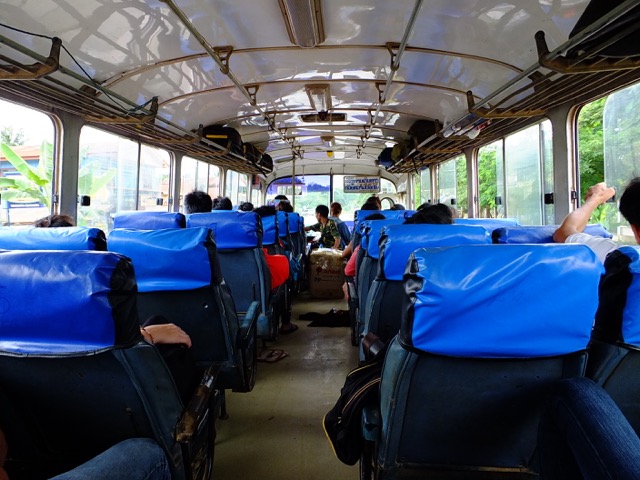
Fast forward 24 hours and we are pulling into the same “bus station”. There are two buses sitting there. A nice big modern one with air conditioning that looks like the one we arrived on and another less ‘refined’ one, that looked like a school bus that had had traveled through a war zone. Windows open, seats ripped, windshield cracked……..you know where this is going!

We asked, “Luang Prabang?” and pointed at the nice big fancy bus. The ticket man pointed over to the other bus and motioned for us to get on. “This might be a long ride,” Clay said as we headed to the dilapidated looking bus. Since the bus had been sitting there for a while, it was already nearly full so we had to make our way to the only empty seats near the very back of the bus. “Oh dear,” I thought! “Do you have the bags ready?” Clay asked.

A few other people got on and the bus set off. Clay promptly pulled out his book and started to read while I tried to perch myself on the edge of the seat such that I could see out the front window and watch the road ahead, hoping to fend off motion sickness. It was then that I noticed the large box in the middle of the aisle that we had climbed around, with a little farmer perched on top. Two rows in front of me in the aisle was a cage filled with rats or moles, I’m not sure which! Whichever they were, they were probably to be sold at the market that night.DSCF9899

Caleb and Connor closed their eyes and tried to sleep in an attempt to stop from getting sick. Again, after about 20 minutes we stopped to let more people on with their goods. Then, after about 1 ½ hours the bus stopped and the driver yelled something. “I think it’s a bathroom stop,” I said, when Clay looked at me. “But there is no bathroom,” he replied. We had parked beside a field with tall grass. Sure enough, as we watched 2/3 of the people on the bus jumped off and found a spot in the field. You could see them doing up their pants as they walked back toward the bus! After 2-3 minutes we set out again.

It was as the bus started off again that both Caleb and Connor remarked, “We don’t feel sick!” I had to agree. With the windows all wide open and the wind blowing in, we didn’t feel car sick at all! True, when we traveled through areas of the countryside where the farmers were burning the fields, it filled the bus with smoke, but it actually felt good to have the air circulating through the bus. Also, there was no fancy curtain covering the front windshield, which they put in the big buses to shade you from the sun; so you could actually see the road ahead.

We arrived in Luang Prabang punctually, 2 ½ hours later and we all agreed, “You can’t judge a bus by its cover!”

Laos (Luang Prabang): A Day in the Life of a Rice Farmer – by Barb, Caleb, & Connor

Rice is such an important crop in Laos, and you see rice field upon rice field everywhere, so we decided that understanding a little bit more about how rice is grown might also help us to understand more about the Lao people. To help us do this we drove to a field outside of Luang Prabang and met Mr. Laut Lee, the manager of the Living Land Farm, and our guide for the day. He would be the one to walk us through the 14 different stages for making rice – from seed to table.

farm sign

Laut Lee provided each of us with a traditional farmer hat. These hats are woven from bamboo and protect you from the sunlight, when working in the fields. Connor’s hat was falling off so he traded it for a smaller one. Off we went for stage #1 of growing rice!

DSCF9253

The first thing the farmer has to do is pick which seeds are suitable for planting. He fills a big barrel with water and adds a fresh egg to it. The egg will sink to the bottom. He scoops in some salt until the egg rises to the top. He does this so that he knows that the water density is correct for seed separation. Next, he puts in the rice seed (rice which has not been husked). The good seed will sink and the seeds which cannot be used will float to the surface. This happens because the good seeds are dense enough to sink. The bad seeds are not strong enough and would not make a good crop. These ones can be fed to the chickens! He scoops out the good seeds and rinses them with clean water to remove the salt. The seeds need to be used right away.

DSCF9269 DSCF9271In order to plant the seeds, you need a plot of land. You sprinkle the seeds onto the surface and wait 3 or 4 days for the seeds to germinate. This is your rice nursery. Once the seedlings are 10 cm tall or so, they are ready to be transferred to the rice paddy but before you do this, you must complete stage 3: ploughing the field!

DSCF9273When we ploughed the field we used Rudolph, the water buffalo to pull the plough. Rudolph walks through the muddy, sloppy area and you hold on to the wooden handle of the plough behind him. You must move the plough back and forth so that it turns up the soil/mud. This is much harder than it sounds, since your feet sink deep into the mud and you are practically dragged behind Rudolph while he saunters around smiling at you!

DSCF9278 DSCF9289 DSCF9293

Rudolph is a pink water buffalo (naturally that colour – not painted!). Water buffalo are used for this job because they are very strong, sturdy and very gentle natured. Rudolph was so gentle that we could climb up and sit on him! I’m not sure he was impressed but he didn’t make a fuss and kept the same “whatever” expression on his face the whole time.

DSCF9279 DSCF9276 DSCF9282

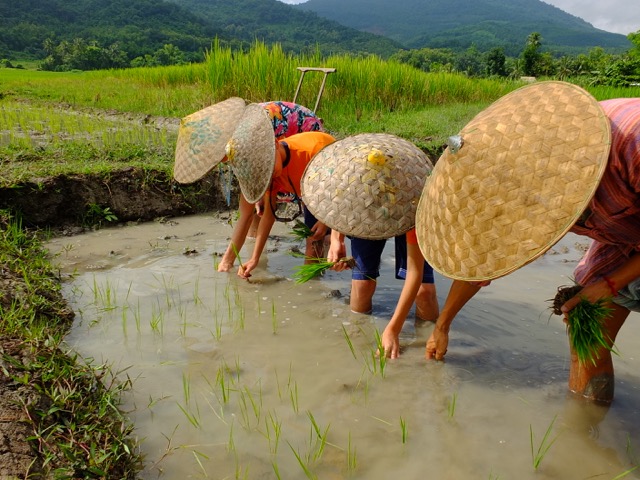
Once the field is ploughed you need to plant the seedlings. To do this, you take 2 or 3 seedDSCF9298lings and push them into the mud. The farmers often get together in large groups for planting and they sing songs to help make it fun. I felt like I was sinking in the mud because it was so mushy, since the rice requires a lot of water to grow. There has to be enough water to lie over top of all of the mud and keep it wet. The seedlings should be planted in rows, but we seemed to have a bit of trouble doing that!

DSCF9300  DSCF9296

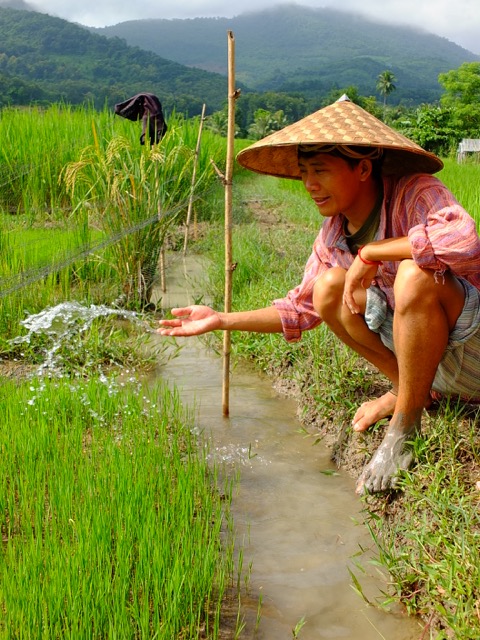
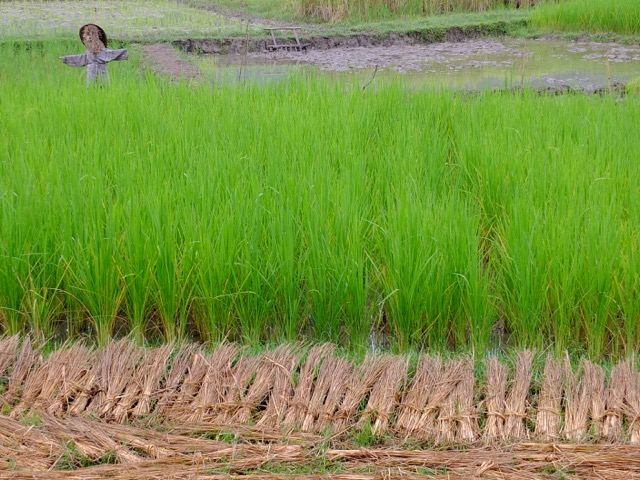
Next, you have to wait while the rice grows. This can take 3 to 4 months. During this time, the farmer has to come and check the water levels of the paddies each day. If there is not enough water, you use your feet to open the irrigation ditches to let more water in. If there is too much water, you take your feet and build a mud dam to block the irrigation ditch. Also, the farmer has to check each of the rice paddies for weeds and pull them out. You also need to put nets on them to keep out the birds. Cats can help to keep the mice away.

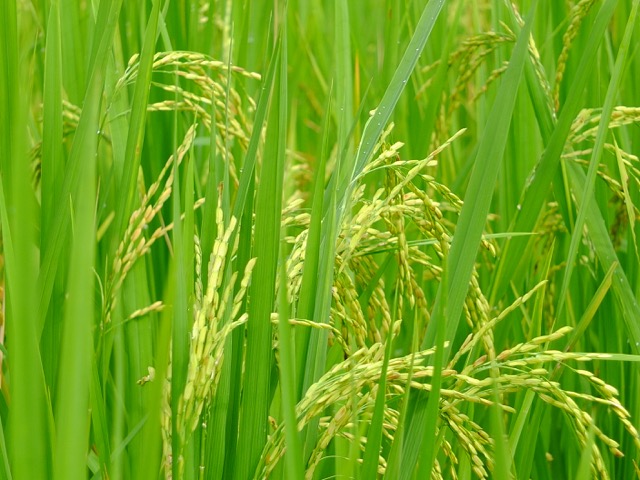
DSCF9274When the rice is fully grown (the plants will be tall and you will see the rice sprouts coming out the top of the plant) you use a tool called a sickle to cut the plants.

DSCF9306 DSCF9275 DSCF9308

DSCF9312 DSCF9309

You leave the bottom of the plant in the mud. (This is the stalk.) You can collect a few stalks together and wrap them with one of the stalks to create a bundle. You then lay them in the sun to dry. This takes 3 or 4 days.

DSCF9259 DSCF9260

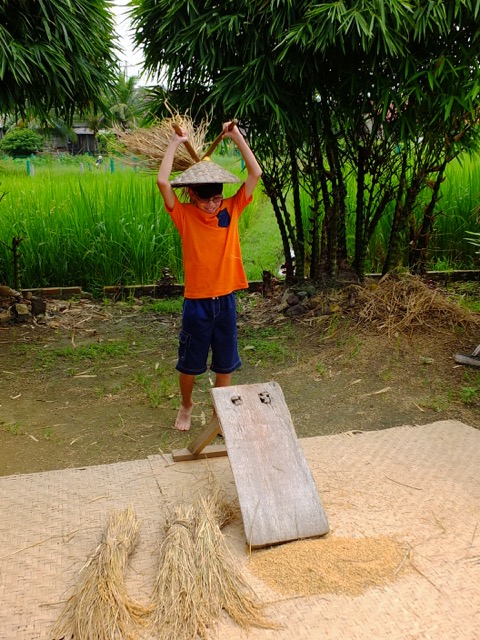
Once the rice is dry you collect the bundles and bring them to an area with a mat and wooden device. You use the wooden device to pick up the rice stalks and you smash the bundle down against a wooden bench to shake out all of the grain.

DSCF9322

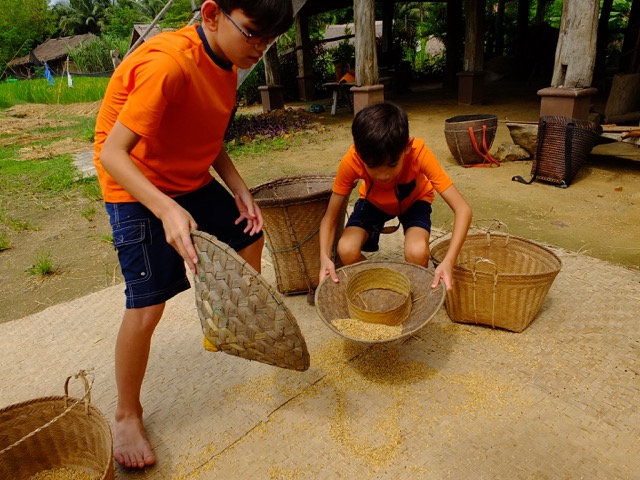
Once all of the grain is out of the bundles you use a large bamboo fan to fan the grain. This will blow away any dead bits of stalk and any bad rice kernels.

DSCF9261

The farmers can use their bamboo hats to scoop up the rice off the mats and put them in large bamboo baskets.

DSCF9334

Different tribes of Lao people have different ways of carrying the baskets of rice back to their house. I tried the backpack method, which is two straps attached to a bamboo basket and you put it on your back. It was comfortable because the basket didn’t have hardly any rice in it!

DSCF9336 DSCF9341

You bring the baskets of rice to your house and need to put handfuls of rice in a mortar and pestle. To make the pestle go up and down you have to step on and off a long piece of wood. The pestle comes down on the rice and cracks open the kernel so that the rice inside comes out. This was not easy to do because the pestle was very heavy and it took a lot of energy to crack just a small amount of rice.

DSCF9344

You pull out a few handfuls of rice from the mortar and put it on a large flat bamboo “winnow”. You have to toss the rice on the winnow in such a way that the husks blow off and you are left with just the rice. When we first tossed the bamboo tray you need to be careful that you don’t toss the good rice with the husks.

DSCF9349

Once you have just the good rice kernels left you can prepare to cook them. The Lao people like sticky rice and that is the kind that we were about to consume. The rice kernels need to be soaked over night and then rinsed before you cook them. The best way to cook sticky rice is to steam it so that the sugars are released, making it nice and sticky.

DSCF9366

This was certainly a meal to remember!

DSCF9427

As a little bonus, Laut Lee showed us many of the tools that he and his family used on the farm. He showed us a machine they had made to squeeze the juice out of sugar cane (and we got to drink some!), homemade mouse traps, their blacksmith set up to make their own knives and sickles and our favourite: a cross bow that he used to hunt fish and animals. We went to his pond and fed the fish, then he told us about how he could catch them with his bamboo bow and arrow. We found this quite hard to believe so he went and got it and shot it at a small fish in the water and hit it!! We had to run and get in his boat and paddle out to pick up the fish. Wow! What a way to get your dinner!

DSCF9264 DSCF9372 DSCF9387

Overall, we learned a huge amount at the farm and we all agreed it was one of our favourite experiences so far. Thank you “Living Farm”!

DSCF9432

Laos (Luang Prabang): Laundry on the Road – by Barb

If you’ve read my post about Packing For Our Trip, you know that we are carrying minimal clothing with us as we travel. We each have enough clothes to get us through a week – though sometimes it means washing a few things in the sink because it’s been so hot and humid (a.k.a. sweaty!).

Many people have asked about laundry. It’s funny because that’s just not something I was worried about. But, after so many inquiries prior to starting the trip I wondered if I should be! As it turns out, laundry is not usually a problem and has been one of the easiest things for us to figure out in each place we stay.

For those of you who are interested, here are some of the ways we’ve managed to do the laundry:

  • When renting apartments in Beijing and Xi’an we had a washing machine. We did have to email the owner to figure out how to use the machine in Beijing, since everything was in Chinese but after sending her a photo of the washing machine controls, she sent back which buttons we should push, in which order and all was well! There was a drying rack in our apartment and we hung everything on it. With the aircon on, it dried not too badly.

IMG_0165

  • In Xi’an, the owner had written English instructions beside the washing machine so we had no troubles there. We brought a travel clothesline and hung our laundry on that.

DSCF8979

  • In Guilin and Yangshuo we stayed in hostels. You could give them a bag of laundry and they would weigh it and charge you by the number of kg. One of our hostels would dry it for you, and at another you got it back wet and could hang it on their rooftop clothesline. Another hostel had a washing machine and you washed it yourself and then hung it on their clothesline.
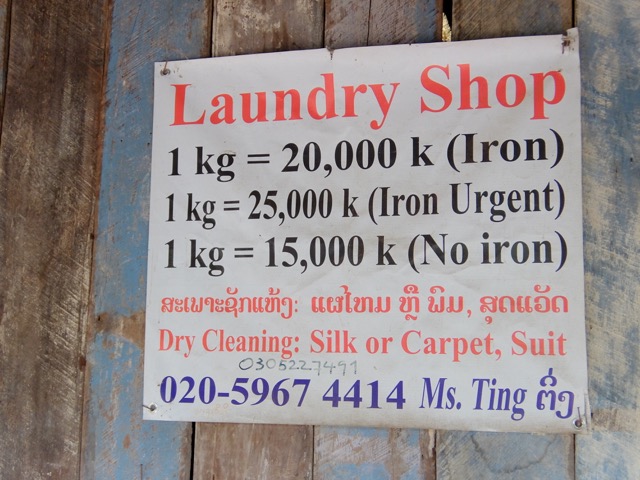
  • At Villa Manoly we saw signs in front of some people’s homes saying they would do your laundry. This laundry “shop” was just down our laneway and the lady brought our clothes back to our guesthouse the next day when they were done.

DSCF9148 DSCF9149

  • At our most recent guesthouse, our host very kindly washed our clothes and we strung a line on our porch and dried them there. With the humidity things don’t dry very well but you do what you can.

And there you have it – the “ins and outs” of our laundry so far. I’m sure we will encounter even more interesting/unique ways to get our clothes washed during the course of the year!

Laos (Luang Prabang): Laid Back in Laos! – by Clay

Laos weather has been fairly rainy, hot and humid, typically reaching 38C with 98% humidity. I don’t really do well in the heat.

We left our rustic bungalow for an even more rustic Organic Farm that Barb had found, where we could see how they were trying to grow produce and livestock responsibly and naturally. Our accommodation consisted of a hut made out of mud. Yes, you read that correctly – mud. Yes, the base was stone and the frame was wood but then they packed mud in between the frame for walls. It really was interesting because they used empty beer and whiskey bottles as “bricks” here and there to allow the natural light to get to the inside. The beds all had mosquito netting tucked around them, not just for mosquitoes but also to protect against beetles, chameleons, spiders, and other creepy crawlies that might want to climb across you as you slept. Fortunately, there was a hammock strung up on the balcony so the boys were pretty happy about that – Connor, in particular.
mud hut
I was hanging up a wet towel one evening (I don’t know why – nothing ever dried in that humidity) and glanced off the balcony and my gaze fell directly onto our next door neighbour. I couldn’t help but look at her for a shocked moment or two and then got my camera, but didn’t say anything to the rest of the family. Here’s a shot of her…

spider
It’s hard to tell these days with massive zoom lenses but I am not exaggerating at all when I say that she was larger than a standard side plate (maybe 6” in diameter). She was only 6 or 7 feet away and her web was firmly anchored to the balcony on which I was standing. I managed to look up ‘spiders in Laos’ and found that very few are poisonous and fewer still are deadly. I couldn’t tell which one this was but I managed to keep a wary eye out in case she decided to wander over for a visit. I double checked the mosquito netting that night, let me tell you!

We had been working on the boys lessons, and with the constant heat we decided to take a break and take a tuk tuk up to the Kaeng Nyui Waterfall for a swim. Our guide lead us through overgrown jungle paths and rickety bridges to bring us to the falls where we able to enjoy a refreshing dip in the cool mountain water.
steps waterfall

cl waterfallb boys waterfall

all waterfall
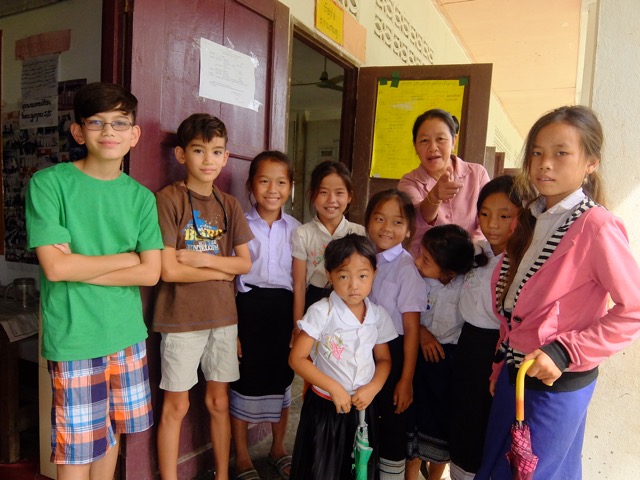
On another day we visited a local school to see what the education system was like. The classrooms were quite spartan in terms of resources and the boys saw quite a difference between their school, and this one. We learned that the students were given one uniform in order to go to school but had to provide their own notebooks and pencils. Barb had brought a number of Canada stamped pencils but we didn’t have enough for each student. In the end we donated some money that helped to provide these kinds of learning materials to the local schools. The students were all lovely and didn’t seem to mind four foreigners wandering about their school.

school room with teacher school boys school girl school
We were booking a bus to get to Luang Prabang and this young Australian couple overheard us and suggested we take the minivan option as it was less “swerve-y” than the VIP bus so we took their advice – but NEVER again! Both boys got motion sickness weaving through the mountains and this minivan was designed to hold 15 passengers. They crammed all 15 of us in there and threw our big bags on the top (while we put smaller backpacks between the seats) and off we went. About 5km down the road we stopped and picked up another person. A little later we stopped again and picked up two other elderly farmers sitting with their produce at the side of the road. There were no seats left so they kind of sat on the floor. Caleb was a little uncomfortable as this little old lady, seated on her sack of rice, leaned against the edge of his seat and then fell asleep, eventually slumping against his arm as she dozed. When she awoke she started sniffing smelling salts (probably in an attempt to fend off motion sickness) which gave us all a headache. And this was our 8 hour bus trip! Barb switched spots with him after a washroom break but we then discovered as it began to pour rain that the van had a leak – right where Barb was sitting! The poor little old lady ended up getting quite sick and her husband looked quite uncomfortable wedged in between the front passenger seat of the bus and the seat behind it. In the end, we survived and we did a +, -, = activity that night. This is where we state the pluses, minuses, and what we’ve learned through the experience.

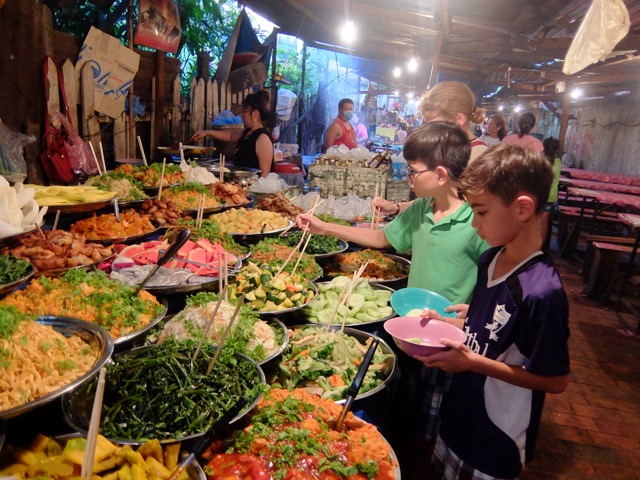
Needless to say, we were all famished when we got to Luang Prabang and our guesthouse host, Andy (who’s from Boston but married and lives local) suggested we try the inexpensive and nearby “night food alley”. Once again, into a grotty alley we go! There are several kiosks that offer a buffet of food where you can fill up your plate or bowl with as much food as you can carry for 15,000kip (about $2.50 Cnd). They are also barbecuing chicken, fish, and pork over charcoal in a lengthwise cut oil drum. There are tarps overhead in case of rain and crude tables and benches have been setup for prospective customers. Cats, dogs, and chickens seem to be wandering at will but nobody seems to mind. Despite the oppressive heat and smoke from the multiple BBQs going the atmosphere is casual and relaxed. There also seemed to be an equal number of locals and tourists so we didn’t seem to stick out any more than anyone else.

food street